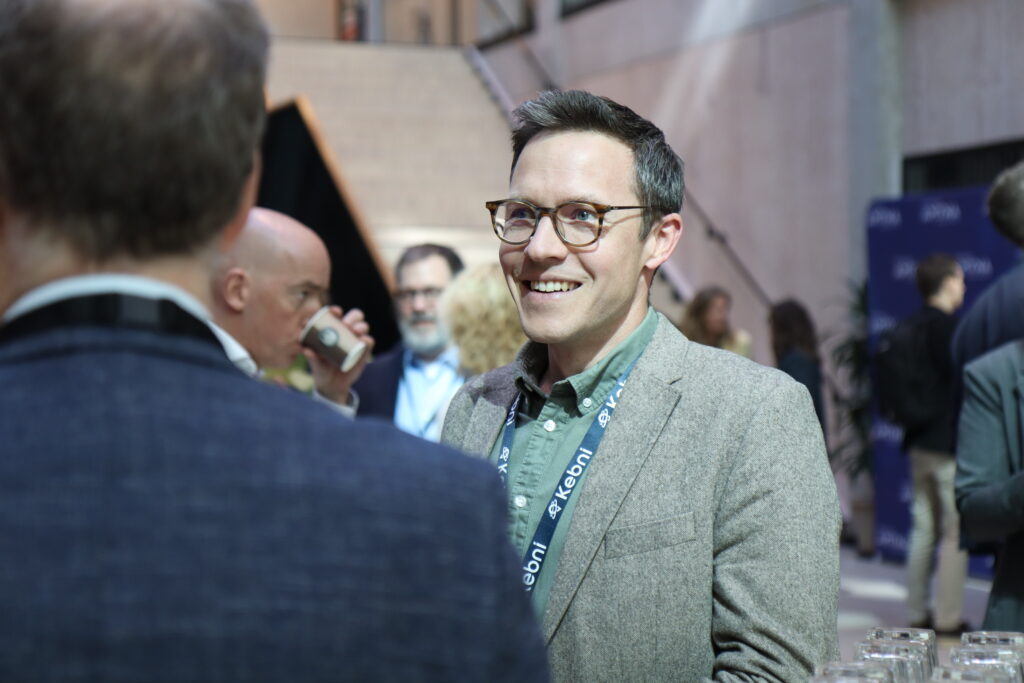
At yesterday’s AI Network’s gathering, Professor Kalle Åström from Lund University shared reflections from decades in AI research, and what it takes to turn today’s rapid breakthroughs into real-world impact.
With a background in computer vision dating back to the 1990s, Åström has followed, and contributed to, AI’s major waves of development. He pointed to the deep learning breakthrough around 2011–2012 as a turning point:
“Many of the vision problems we struggled with before are now essentially solved.”
But while earlier progress was driven by solving technical challenges, today’s shift is different.
“We are living in the age of LLMs. The question now is: how do we use these models in systems, so that we can get the most out of it and so that it works?”
According to Åström, the real challenge is no longer building models but integrating them.
“Making AI useful requires significant effort in combining technologies, testing them in context, and ensuring they deliver value in practice.”
This is particularly evident in areas like autonomous systems, where his work includes generating complex scenarios to test how AI models behave in real-world situations.
“Innovation today is about making the tools useful”, says Kalle.
Collaboration between academia and industry
A recurring theme throughout the talk was the importance of close collaboration.
Through initiatives like AI Lund, Lund University is working to connect research, education, and external partners, supporting everything from student projects to industrial PhDs and joint innovation efforts.
Åström also highlighted emerging trends shaping the field:
- Generative AI transforming how we write and understand code
- New approaches to solving complex problems, including in mathematics
- Progress in applying AI to 3D geometry; an area long considered difficult for deep learning
At the same time, he emphasized the need to strengthen the broader ecosystem around AI:
“We need better support systems; training, collaboration, and ways to connect startups, research, and industry.”
As AI continues to evolve at high speed, the message was clear: the next phase will be defined not just by technological breakthroughs, but by how well we turn them into something that works.
Join the AI network (Ideon Science Park, Innovation Skåne, Minc, Hetch): https://ideon.se/community-networks/
Join the AI Lund network https://ai.lu.se/nwreg/
See you next time, in May, at Hetch in Helsingborg. Stay tuned: ideon.se/events
The AI network is run by Ideon Science Park, Minc, Innovation Skåne and HETCH, and financed by Tillväxtverket and the EU.