How Solstice turned academic curiosity into a breakthrough for fossil-free industry
When Martin first suggested moving the motor on a solar mirror system, the response was polite, yet dismissive. “It is a really cool idea,” they told us. “But it will not work.” Martin did not agree and also did not let go of the idea. Today, that “impossible” idea is the foundation of Solstice, a Lund-based startup developing solar-powered heat batteries that could help energy-intensive industries cut both emissions and costs.
It Started at the Faculty of Engineering, with a Real-World Problem
Martin and Hampus met while studying engineering at Lund University’s Faculty of Engineering (LTH). During his studies, Martin took part in a course where engineering students worked directly with companies facing real technical challenges.
One of those companies manufactured solar concentrators using mirrors and Stirling engines to convert solar heat into electricity. When the company explained their system, one problem stood out.
“Most of their product issues came from a large motor hanging above the solar mirror,” Martin recalls. “So, we suggested that they should move it.”
The students proposed relocating the motor and transferring energy in a different way. The company liked the thinking but rejected the idea.
Martin could not let it go.
“I was convinced it should work,” he says. “So, I started looking for proof.”
From Research Papers to the Solar Lab
Martin dove into scientific literature and found evidence that similar principles worked elsewhere.
“I got in touch with researchers at LTH and initiated experiments in the university’s solar lab.”
With support from Venture Lab, he managed to finance these early tests in his spare time.
That is when he called Hampus, whom he already knew from their time on the Formula Student project. Hampus, with his hands-on engineering experience, quickly became deeply involved, eventually basing his master’s thesis on the experiment.
“We could clearly show that it worked, exactly as we had predicted,” Hampus says.
The idea was no longer academic. It was real.
Evenings, Weekends…and the First Pitch
While finishing their studies, Martin and Hampus continued developing the concept during nights and weekends, preparing it for commercialization.
At one of their first pitches at Lund innovation future award, Malin Eriksson was in the audience.
With a background in economics and experience from the innovation ecosystem, including VentureLab, Malin was actively looking for a sustainability-driven project.
“I didn’t fully understand the technical pitch,” she admits. “But I could tell there was something interesting there. And Martin and Hampus seemed like people I wanted to work with.”
They went for coffee. Malin soon started working with the team during her MSc. She brought a strong commercial perspective that complemented the duo’s technical focus. The match was clear, and she later joined as a co-founder.
Building a Company Without Quitting Their Day-Jobs
For nearly two years, the trio built Solstice alongside full-time studies and later full-time jobs.
“We booked late meetings, flexed hours, and worked like crazy,” Martin says.
The challenge was clear: the solution was capital-intensive.
“We believed in this completely,” Martin explains. “But belief does not pay for materials.”
Early grants and scholarships helped but were not enough.
In 2025, everything aligned. Solstice secured two major grants, including funding from Vinnova and the Swedish Energy Agency.
“The timing was perfect,” Martin says.
“If we had only received one of them, it would have been really difficult,” Malin adds. “Now we got both funding for materials and time to bring the innovation to the market.”
On October 1, all three founders quit their jobs to focus on Solstice full-time.
The Technology: Solar Heat, Stored as Heat
Solstice’s solution is a solar-driven heat battery.
“We use solar mirrors, not solar panels, to capture energy and transfer it into a sand battery,” Martin explains. “It is essentially a silo filled with sand that can be heated to extremely high temperatures.”
Unlike conventional systems, Solstice never converts heat into electricity. Heat alone is just as useful and far more efficient.
“It is heat to heat to heat,” Hampus says. “That is sort of the secret sauce.”
Sand batteries already exist. Solar mirrors, too. But no one had combined them in a way that efficiently charges sand directly with solar heat.
“Using electricity to heat sand is expensive and inefficient,” Hampus explains. “Energy storage has traditionally been costly batteries especially. This is a smarter alternative.”
A Game Changer for High-Temperature Industries
Many industries want to phase out fossil fuels, but only if it is cost-effective.
“With our solution, an industrial customer can cut their energy costs by up to 50 percent,” Hampus says.
While Solstice initially targeted large energy companies, the team soon discovered strong demand among smaller, heat-intensive industries, such as food production, glass manufacturing, and chemical processing.
“In these sectors, we can make many smaller installations and validate the technology and customer value before we go for larger industrial customers”, says Martin.
Temperature is the key differentiator.
“Low-temperature heat, like 80 degrees, is easy,” Hampus explains. “But many industries need very high temperatures, 400, 800-1000 degrees. Today, that almost always means burning fossil fuels.”
Solstice can deliver those temperatures, renewably.
What About the Sun in Sweden?
Yes, Sweden is not Spain. But that is not a dealbreaker.
“From April to September, we can deliver all the heat a customer in Sweden needs”, Hampus says. “Closer to the equator, we can provide 100% of their heat demand year-round.
This, at a very competitive cost.”
For industries currently burning oil or gas, that is a major shift.
And globally?
“We are aiming for international expansion,” Malin says, “As well as for an all-year-round application.”
What’s Next for Solstice?
Right now, Solstice is building its first small-scale installation.
“We have secured non-dilutive funding and have a solid runway,” Malin says. “That allows us to focus fully on product development.”
The company has moved into offices at Ideon Science Park and is preparing to demonstrate the technology in real industrial environments.
“We are in an intense development phase,” Martin says. ”We are now planning to raise our first pre-seed round and are actively applying for the bigger EU-grants.”
By 2026, Solstice expects its first customers to see real savings – and real impact.
“Already this year, we will show that this works,” Martin says. “Not in theory, but in reality.”
Learn more: www.solsticestorage.com
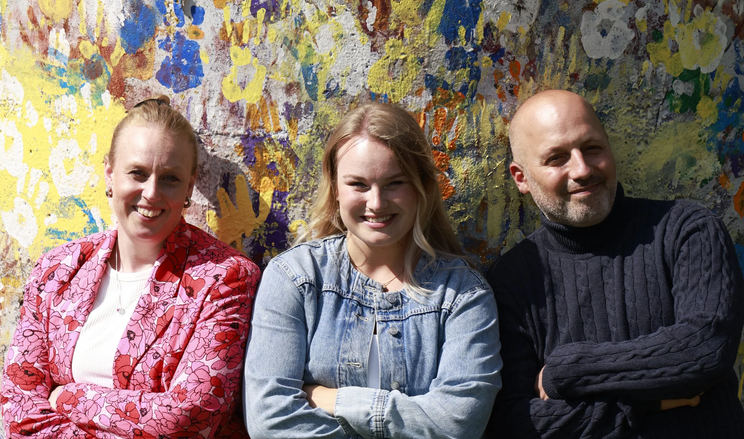
The team:
COO Malin Eriksson (MSc innovation & entrepreneurship)
CEO Martin Arvidsson (MSc Electrical Engineering)
CTO Hampus Hammarbäck (MSc Mechanical Engineering)