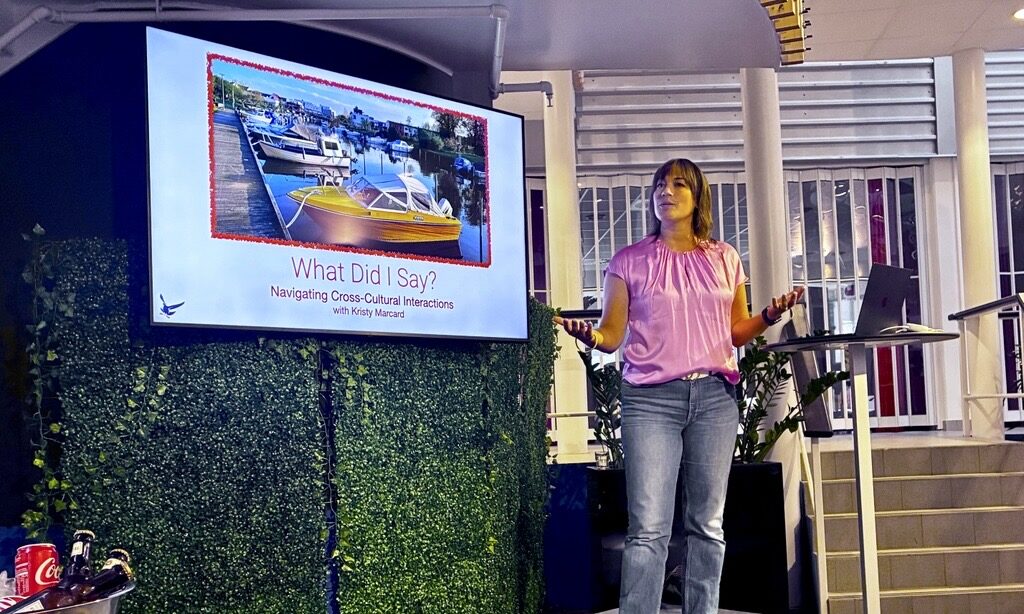
At Career Day Tech today we learned about different working cultures, and specifically the Swedish – also in relation to the Danish. Intercultural expert, Christina Rundcrantz talked about workplace culture and the power of intercultural competence. One takeaway was clear:
When we can identify cultural differences, we can bridge them.
Intercultural competence, something you can put on your CV if you are good at it, is not about becoming someone else. It is rather about knowing your own style, understanding others, and staying curious enough to adapt when needed. Christina called it developing your CQ Cultural intelligence, the ability to work effectively across cultures.
Some highlights that stood out:
Culture belongs to groups, not individuals.
Christina asks the audience permission to use generalisations. These are not the same as stereotypes, says Christina, and can be a useful starting point for understanding people and getting to know other cultures.
Don’t minimize cultural differences. Acknowledge them.
We should be aware of the fact the cultures are different. There is nothing controversial about that. Instead, Christina encouraged us to learn more. There is good and bad in all cultures. Stay yourself but tweak your behaviour when the context calls for it.
Treat people the way they want to be treated.
There is no universal feedback style, no universal way of communicating. Stay true to yourself, but be willing to adapt.
Christina also explored Scandinavian cultural traits — especially the Swedish–Danish similarities: egalitarian leadership, high trust, informality, modesty, and a strong belief in work–life balance.
As she put it, Sweden is often seen as the extreme of “lagom” (=just the right amount [ in Swedish)], an interesting paradox.
From researchers on culture by Richard Lewis to Erin Meyer and Hofstede’s cultural dimensions, Christina lands in the key outcome that diversity and cultural dimension enrich working life and organizations. Especially, if we understand the values behind our behaviours.
Whether we come from survival-oriented cultures or self-expression cultures, traditional or secular values, our differences shape how we listen, lead, give feedback and make decisions.
With curiosity, awareness, and willingness to adjust, we can turn these differences into strengths.
Culture is not a barrier, it’s a bridge.