What does the future of the Swedish space industry look like? Where does Sweden stand today and how can we compete on a global level? These questions, and many more, were discussed during the GoWest breakout session “The Future of the Swedish Space Industry.”
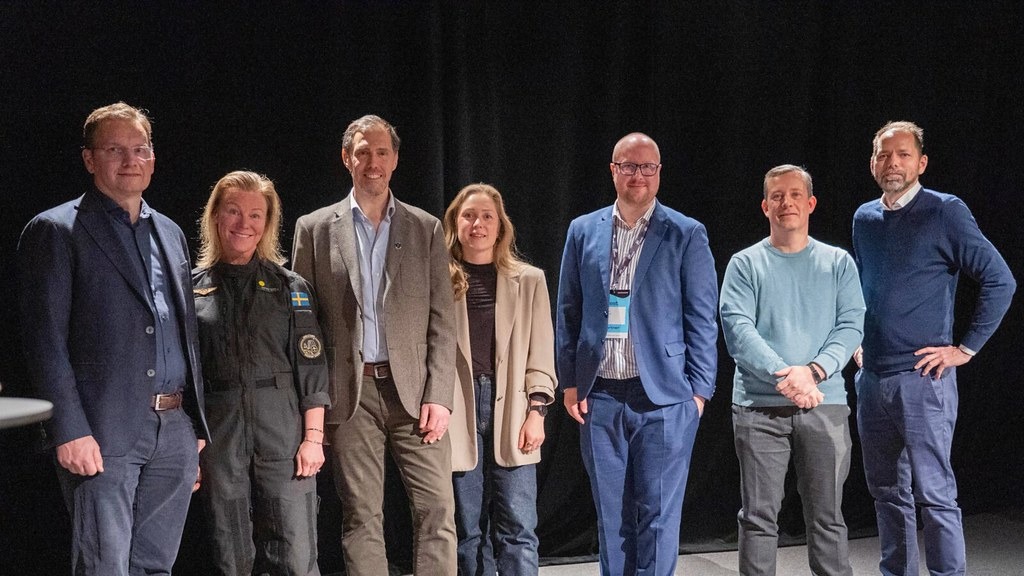
The session was organised by Space Sweden, a collaboration between Ideon Science Park, Innovatum, Uppsala Innovation Centre, and Arctic Business Incubator, and brought together a diverse panel of stakeholders to explore the opportunities, bottlenecks, and realities of NewSpace in Sweden.
The NewSpace Era Is Here: But What Does It Mean for Sweden?
With decreasing launch costs, smaller satellites, and the growing role of private players, access to space has improved dramatically in recent years. Market forecasts suggest that the global space economy could grow to be worth nearly $1.8 trillion by 2035, highlighting space as a major commercial and strategic opportunity. Furthermore, the geopolitical situation has underlined the strategic importance of space capabilities.
It is therefore not surprising that many actors are eager to “ride the NewSpace wave.” However, a major challenge quickly became clear during the discussion: there is no shared understanding in Sweden of what NewSpace is or what actions are required to create it domestically.
Procurement, Policy, and the Missing Customer
Aaron Dinardi, who was an early employee of SpaceX and is currently the Managing Director of Space West, was directly involved in the original emergence of NewSpace in the United States. Now active within the Swedish space ecosystem, he argued that Sweden must first understand what NewSpace truly is. According to Dinardi, NewSpace ultimately comes down to the use of new procurement methods and how governments interact with industry, areas where the current Swedish system is acting to prevent rather than enable the necessary changes. While Sweden admires the U.S. space system for its results, Dinardi noted, it is reluctant to adopt the mechanisms that are required to make those results possible.
Johan Vaernholt, former Swedish military officer and Head of Business Development at Ideon Science Park, agreed that although space is on the political agenda and funding exists, progress is hindered by a lack of shared definitions and alignment. Without this, moving forward becomes difficult.
Old Space vs NewSpace: A Misleading Debate?
On the other side, Ernesto Gutiérrez from the Swedish National Space Agency (SNSA) suggested that the “Old Space versus NewSpace” debate risks becoming a distraction. Rather than focusing on disagreements, he argued, Sweden should concentrate on areas of consensus and recognize that different actors play different roles within the ecosystem.
Gutiérrez expressed optimism that Sweden can succeed if everyone works together. At the same time, he acknowledged the complexity of the landscape and pointed to a clear knowledge gap within municipalities and public agencies when it comes to understanding and using space data. Without this competence, agencies struggle to act as customers, limiting demand for space-based solutions.
Innovation Is Not the Problem, Commercialization Is
Dinardi challenged the idea that consensus will drive change. He argued that if we want to establish NewSpace in Sweden, we need to stop listening to the people who are either defending the status quo or advocating for the wrong kinds of changes. He explained that in order to make NewSpace possible here, Sweden’s political leadership must choose to enable only those who possess relevant knowledge and experience – which also means actively preventing all the other groups from continuing to stand in the way of the necessary changes.
Michael Schön, with experience from ESA, NASA, and Volvo Cars, reinforced this view by highlighting Sweden’s commercialization gap. Sweden, he argued, does not lack innovation; it lacks the ability to scale companies through the “valley of death.” As a result, Swedish space companies are choosing to relocate to other countries like Finland, where the NewSpace ecosystems are perceived to be more supportive.
Addressing why Finland has been more successful in attracting companies and capital, Dinardi pointed out that Sweden and Finland have taken fundamentally different approaches in their national space strategies, with Sweden lacking the flexible procurement mechanisms that are needed to enable NewSpace development.
The Cost of Inaction
Vaernholt further emphasized that Sweden invests heavily in building competence but fails to provide the ecosystem needed to retain and grow those capabilities. The result is a system where the most difficult customer or investor to secure is a Swedish one, and where there is no clear anchor customer willing to “pick up the phone.”
Throughout the panel discussion, a recurring theme emerged: there is ambition and opportunity, but decision-making in Sweden is too slow – and risk aversion is high.
From Strategy to Execution
So, how can Sweden begin succeeding in the NewSpace era?
The opportunity is huge if we get this right, said Dinardi, but Sweden has a problem making decisions. He argued that you do not change the system by talking, but by showing what works, pointing to flexible procurement models such as the “Other Transaction Authority” (OTA) framework in the U.S.
Schön took a longer-term view, suggesting that markets will ultimately regulate themselves and that the coming years will present many opportunities for those prepared to move.
Vaernholt, however, stressed that progress requires more than vision. Sweden must align around common definitions, shared goals, and concrete actions. Fear of making mistakes cannot continue to outweigh the cost of inaction.
Gutiérrez concluded by reiterating that strategy is the result of an ongoing process and that the discussion itself reflects the complexity of the system. The overarching goal, he emphasized, must be to make space relevant for society, across defense, environment, energy, and transportation.
A Critical Moment for Swedish Space
The discussion made one thing clear:
Aligning definitions, strengthening public-private partnerships, and enabling flexible procurement models will be critical if Sweden wants to compete in a global and fast-moving space economy. While a strong innovation ecosystem can support this development, it is not enough to create it. Political willingness to change strategy is crucial.