With roots in Kockums’ submarine engineering and its headquarters at Ideon Science Park, Stirlingversal is now scaling up to solve one of the most urgent challenges of our time: how to generate reliable, local, and emission-free electricity from waste heat that would otherwise be lost.
“We want to show that there are already solutions that are scalable, clean, and robust. The technology exists, now it is about bringing it to the world,” says Magnus Halväng, CMO.
A Skåne Innovation Gains Momentum
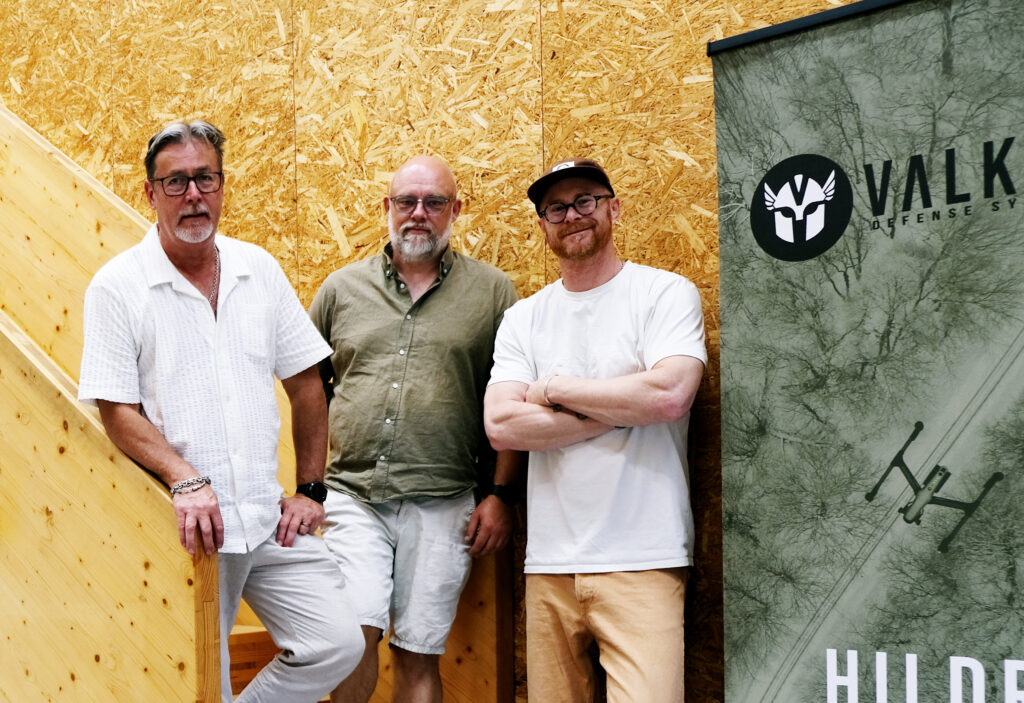
The company was founded in 2017 by Håkan Garmer, Tore Svensson och Lars Larsson.
Lars and Tore came from Kockums, where they had worked for many years with the Stirling engine, the reliable and silent engine used in several Swedish submarines.
Håkan contributed 17 years of experience working in and with China. This was a valuable asset when the company later established its own supply chain and factory in Kunshan.
“It was Lars and Tore who ensured that Stirling technology was implemented in submarines, not only in Sweden but also for example, in Japan,” says Håkan.
During their work, the trio identified that the Stirling technology had potential far beyond military applications.
“The Stirling engine converts high heat into electricity,” Håkan explains.
This became the business idea: to generate green and local electricity from waste heat, industrial off-gases, and biofuels.
How the Technology Works – Electricity from Waste Energy
The technology was originally engineered by Kockums for extreme conditions under the sea. This means that it is reliable for many years, requires minimal maintenance, uses no rare metals, is silent, and withstands gases heated to over 800°C. Stirlingversal has further developed the technology to handle a wide range of hot gases and to be suitable for volume manufacturing.
“We do not use any unusual materials, but mainly steel, nickel-based alloys, and other standard materials. No combustion, no emissions, no suspicious substances. This is truly sustainable technology, in our view,” says Håkan Garmer.
The Stirling engine operates through external heating. There is no combustion inside the engine itself, making the technology both clean and stable. Customers provide the heat, often something they already have. It can come from industrial waste heat, biofuel, pyrolysis gases, wood chips, or forestry by-products.
The engine converts this heat into electricity and thermal energy, making it a suitable solution for industrial sites and buildings.
“A single module covers the electricity needs of 8–10 Swedish villas, for comparison. Several modules can be connected in parallel for redundancy and higher output,” Håkan explains.
A Global Company Built on Expertise from Skåne
Stirlingversal currently has around 16 employees in Sweden and China, with headquarters at Ideon Science Park in Lund. The company operates a complete factory and supply chain in Kunshan, China. The CTO and engineering teams are based in Malmö.
“We have 0% staff turnover in our Chinese operation,” Håkan notes. “It has taken a long time to build our supply chain. Continuity and quality are essential. We don’t produce anything we can’t stand behind for the next 25 years.”
Swedish experts ensure quality and process leadership.
“Our customers essentially already have the energy. We simply help them use it.”
In Asia, demand is high, especially in China, where the company already has significant partnership agreements, but also in Japan and other parts of the region. The technology is now gaining attention in Scandinavia as well. Stirlingversal collaborates with Swedish companies, universities, and industrial partners in the region, where material and system tests are underway.
“Our technology fits wherever there is heat. That makes it flexible and globally relevant,” Magnus says. “This includes off-grid solutions, local microgrids, factories, sawmills and process industries, agriculture and forestry, waste and pyrolysis plants, or municipal energy production.”
Toward Large-Scale Production
The company is now entering a scaling phase.
After several years of technological development and caution, to avoid raising expectations during the global component shortage, production is now increasing to meet global demand.
“We have built our foundation carefully, “says Magnus. “And we now ready to scale. We show results through our technology that is inherently sustainable. It converts waste energy into electricity without emissions and operates for decades.”
Stirlingversal is an example of how engineering expertise from Skåne, international collaboration, and entrepreneurship can create solutions that contribute to both the energy transition and industrial competitiveness.
Get in touch to learn more:
www.stirlingversal.com