Inside the Swedish team developing a low-cost autonomous system designed to stop FPV drones at the frontline, before impact.
At first, it was about supplies; truckloads of supplies.
When Russia’s full-scale invasion of Ukraine began, Peter Arndt’s friend Petter and his network mobilized quickly, sending everything from hygiene products to critical frontline equipment into Ukraine. Over time, more than sixty trucks would make the journey.
But as the war evolved, so did the conversations.
“We formed relations in Ukraine and started asking different questions,” says Peter Arndt, who is one of the founders and the Chairperson of Valkyr Defense. “Not just what people needed, but what was happening at the front. What were the real problems?”
The answer was drones, thousands of them. Every single day.

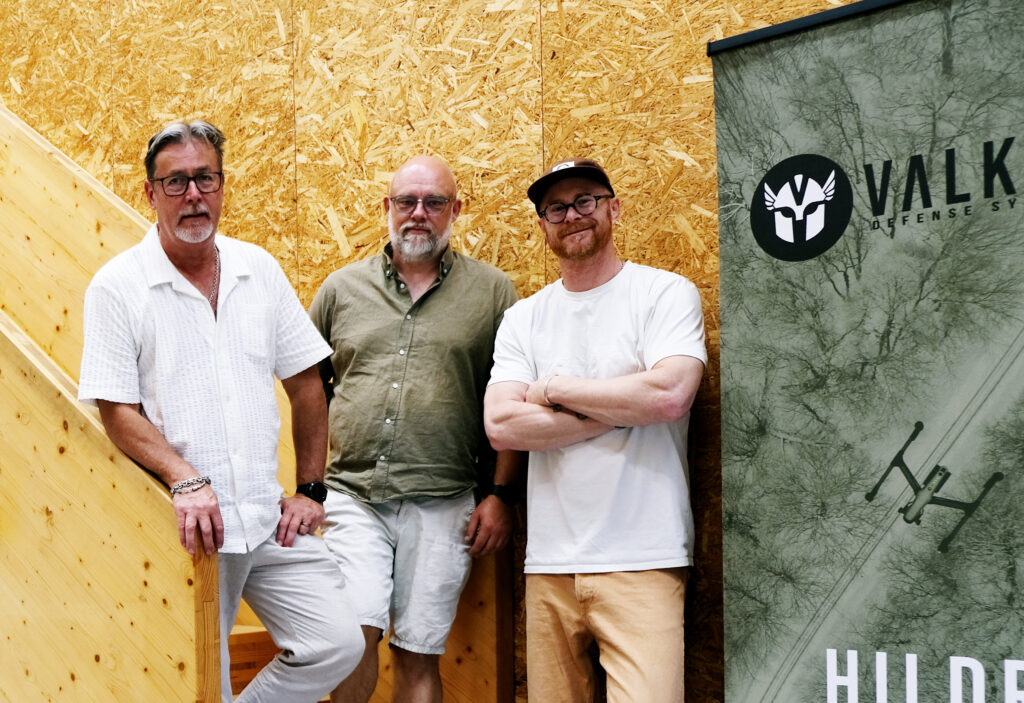
Peter Arndt, Founder, Valkyr Defense
“There Is No Way to Defend Against Them”
A year and a half ago, the battlefield looked very different. Today, FPV drones — small, agile “kamikaze drones” controlled by pilots kilometers away — dominate frontline warfare.
They swarm vehicles, they strike bunkers and they target logistics routes. And according to Arndt, they are one of the main reasons the war has reached a deadly stalemate.
“Only around thirty percent of vehicles make it to the front and back today,” he says. “Everything else gets destroyed.”
Traditional countermeasures are struggling to keep up. Many soldiers still attempt to shoot drones down manually using shotguns. But humans simply cannot react fast enough against drones moving up to 200 kilometers per hour.
“That is why nobody is advancing,” Arndt explains. “Thousands of drones are launched every day, and right now there is no effective defense. The war has fundamentally changed because of FPV drones.”
That realization became the starting point for Hildr, Valkyr Defense’s autonomous close-range defense system designed specifically to stop FPV drones in the final seconds before impact.
Building the “Last Line of Defense”
Unlike long-range missile systems designed to intercept large aerial threats kilometers away, Hildr focuses on something different: near protection.
Very near.
“We call it the last line of defense,” says Arndt. “When the drone has already made it through everything else, we are the final protection layer.”
Mounted directly onto vehicles or stationary infrastructure, the system combines sensor technology and countermeasures employing kinetic effects and nets.Four coordinated units, with one master, can work together autonomously, tracking and neutralizing swarming drones at distances between zero and thirty meters.
And unlike expensive missile-based systems, Hildr is intentionally designed to be low-cost.
“We use the world’s most mass-produced ammunition,” Arndt says. “It might cost five kronor to take down a drone instead of fifty thousand.”
A Team Built for Speed
Behind the system is a team deliberately assembled for rapid execution.
Arndt, who has spent three decades bringing industrial innovations to market, joined forces with defense veteran Petter Hegnelius, industrial designer Magnus Göransson, business developer Stefan Westergård and Estonian supply-chain expert Reio Rahumagi , combining expertise in defense systems, usability, manufacturing, and commercialization.
“We are all over fifty,” Arndt says with a laugh. “That also means we have decades of experience. We built a team specifically to move fast.”
And speed matters. In Ukraine, technology cycles are measured in weeks, not years.
Drone warfare evolves constantly. What worked six months ago may already be obsolete.
“We Were the Only Company That Actually Went to Kyiv”
Earlier this year, the team traveled to Kyiv to meet with Ukrainian partners specializing in detection systems, sensor technology, and AI vision.
The experience left a deep impression.
“They told us we were the only company that had actually come there in person,” Arndt says. “Everyone else just talked.”
The visit reinforced the urgency of moving faster, not only technologically, but politically and industrially.
“If you want to understand what is really happening, how they live and what the war looks like, you have to go there,” he says. “And you realize very quickly that Europe is moving far too slowly.”
“They did not need more promises. They needed solutions.”
The collaboration with Ukrainian partners is now central to the development process. Access to real frontline data and operational realities is essential if systems like Hildr are going to work in practice.
“You cannot develop this in isolation,” Arndt says. “The battlefield changes too quickly, which is why being in touch frequently with our partners in Ukraine is key.”
The Hidden Side of the Drone War
One of the most striking aspects of modern drone warfare, according to Arndt, is how little the public truly understands its scale.
Fiber-optic drones, impossible to jam electronically, are now flown through ultra-thin cables stretching kilometers across the battlefield.
“Ukraine is producing 150,000 to 200,000 drones every month,” he says. “Thousands fly every day.”
The environmental consequences alone will be enormous; to get rid of all the threads in the landscape. The human cost is even more immediate.
Soldiers reinforce bunkers with nets and barriers. Vehicles are modified in desperate attempts to survive. Yet, highly skilled drone pilots still navigate directly through openings and strike targets with devastating precision.
“These pilots are incredibly skilled,” Arndt says. “We have seen videos where they fly straight through gates and directly into bunkers.”
Navigating a Slow-Moving System
While the battlefield moves at extreme speed, regulation moves far slower.
The company recently became one of the first new Swedish companies in decades to receive a weapons manufacturing license from ISP, the Swedish Inspectorate of Strategic Products.
The process took nine months.
“In startup terms, that is an eternity,” says Arndt.
The regulatory burden remains significant. Every meeting, discussion, and industry interaction must be documented and reported.
“It is not impossible,” he says. “But it is a completely different world compared to building a normal industrial startup.”
Still, momentum is building.
The company is now finalizing its investment round while exploring alternative funding routes through NATO programs, European defense initiatives, and direct collaboration with defense organizations.
“This Is Not About Building Another Product”
For Arndt, the project ultimately became personal.
After decades of product development, he says this is the first time his experience feels directly tied to saving lives.
“This is not about making another consumer product,” he says. “This is life and death.”
And after standing in Kyiv, hearing firsthand how rapidly the battlefield is changing, the mission became even clearer.
“I think there is too much discussion about how good we are (in Sweden) at sending support and money to Ukraine,” he says. “Too little discussion about what people there are actually living through and what the battlefield actually looks like.”
“If we truly want to help, we need to move much faster.”