Next Step: Expanding and Accelerating Growth
For companies that have come a bit further in their growth journey, a common next step is Series A and Series B financing. Unlike pre-seed financing, which is the very earliest phase and focuses on turning ideas into business operations, Series A and B mean that your company has already proven your potential and is seeking capital to accelerate your growth.
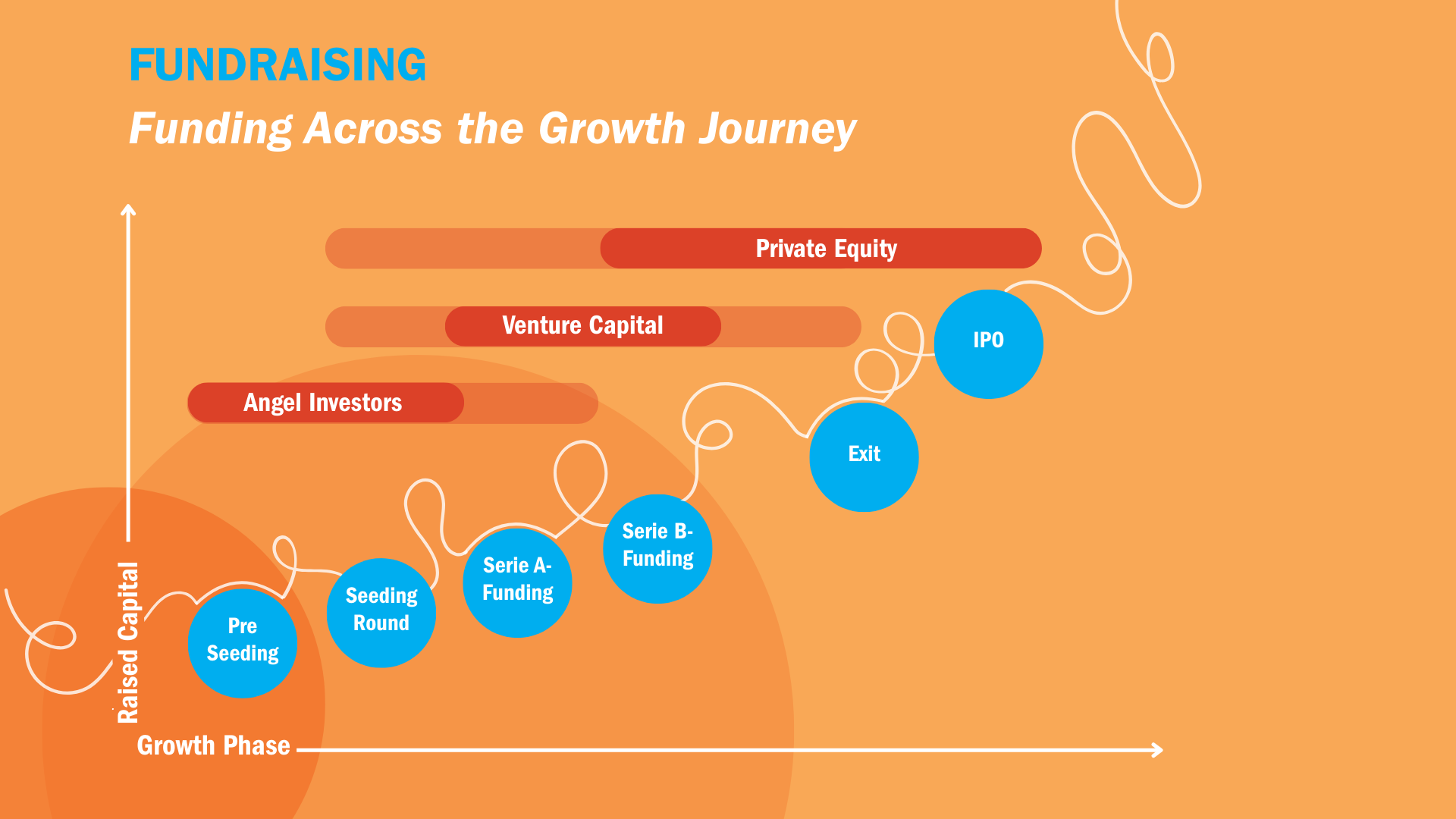
Series A financing takes place when you have a functioning product and have started to generate revenue. Capital is often used to expand the team, develop the product, and scale up the business.
Series B financing comes later. It is often aimed at further accelerating growth, often by expanding into new markets and increasing market share.
Watch out for “dirty term sheets”! These are investment terms that are strongly advantageous for the investor and can be harmful for you as an entrepreneur. This can include high liquidation preferences, anti-dilution protection, and rights that give the investor significant control over the company.
Funding Options During Step 2
- Venture Capital
- Business Angels
- Private Equity
Key Metrics You Will Want to Focus On
Revenue growth: Show your company’s ability to increase its revenues over time.
Cash flow: If cash flow is not already positive, it is now high time that it becomes so.
Income statement: Focus on gross margin, EBITDA, and EBIT.
Working capital: Keeping track of tied-up capital is central for seeing growth potential.
Expert tip (Sweden specific)
Investigate the possibility of applying the “outsider rule,” which may apply if there are passive external owners with at least 30 percent after a qualifying period. In that case, dividends and capital gains may be taxed at 25 percent.”
Joanna Bertlin, Authorized tax advisor, Grant Thornton
Venture Capital: Rapid growth and valuable expertise
Professional investors within venture capital typically invest larger amounts and in more mature companies than angel investors. Generally, they are more established actors with expertise in business strategy, marketing, specific industries or expansion phases, international expansion, etc.
Venture capital funds often receive their capital from institutional investors such as pension funds, insurance companies, and asset managers, and can quickly invest more capital if needed.
A strong advantage is precisely the expert competence, the strong financial resources, and the framework that allows the founder to get help in the areas that require the most resources.
Reduced control and ownership
Actors within Venture Capital are accustomed to setting high demands and goals for the journey ahead and expect strong growth and value creation.
As an entrepreneur, it is important to have a clear plan for what the capital will be used for and to link this to a timeline. What will the capital be used for here and now, and what might be needed in the next step?
Venture Capital actors also want a clear exit horizon. As a condition for the investment, there will be demands for a clear plan for when and how you intend to take the company to its next stage.
This content was developed by our partners Grant Thornton. Courtesy of Grant Thornton; Thank you for sharing your insights. Grant Thornton offers tailored guidance based on startups’ & scale ups’ unique journeys.