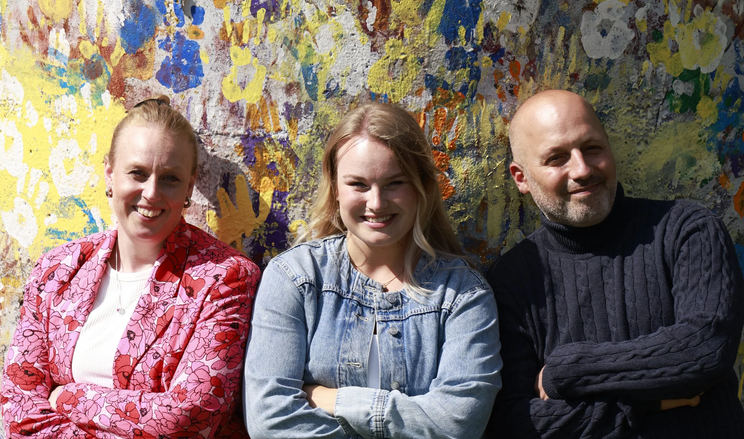
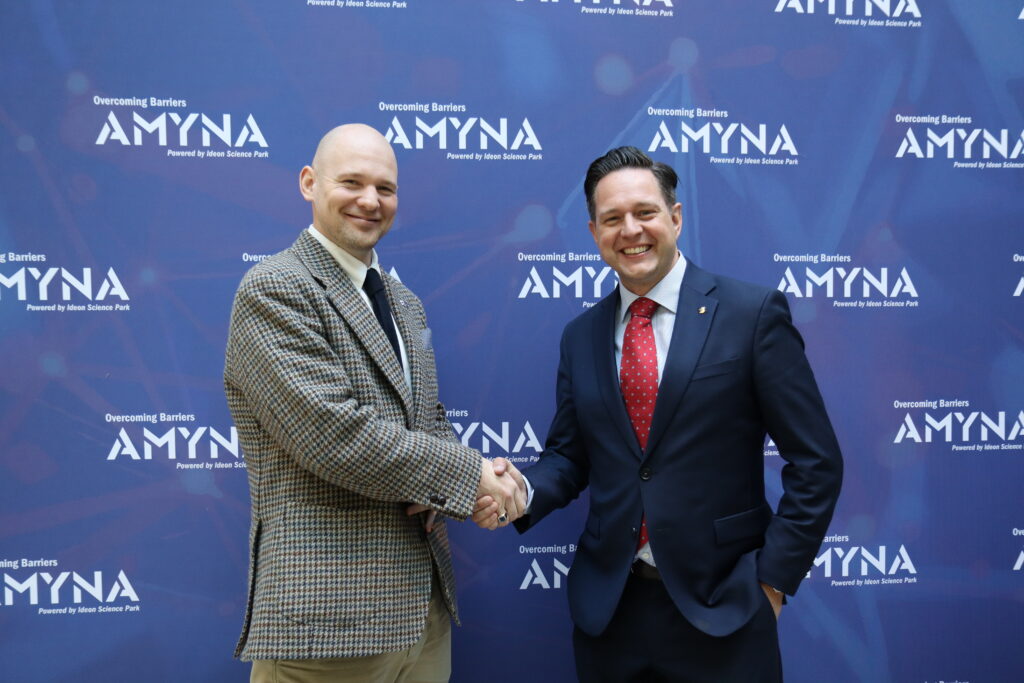
“A few years back, I threw myself into the startup world,” says Stefan Svedberg, CEO of BeammWave. “I joined two very different journeys: BeammWave and AlixLabs. The latter I co-founded. Both companies are deep-tech companies; ambitious, capital-intensive, time-consuming – and yes, expensive.”
Built on Technical Legacy
The two start-ups became operational in 2019, but their technological roots run deeper.
“The technical founders had been working on the concepts for five or six years before we formally launched. The groundwork was already laid, with patents filed, ideas shaped.”
What BeammWave Does
BeammWave develops beamforming solutions – directing radio waves electronically to vastly improve wireless communication; to make it more efficient and cheaper.
“The team has achieved a lot. And among other things, we have raised over SEK 150 million, says Stefan.
Developing complex hardware and software is not cheap:
“The funding journey becomes part of your daily strategy. It is a constant balance between what you are building and how you will finance it.”
Why BeammWave Exists
There is a clear reason why BeammWave was founded.
“People want to surf on their phones, fast and affordably. But data demand keeps growing. And that increased capacity costs money for the operators,” explains Stefan.
As the radio spectrum becomes crowded and the most accessible frequency bands are exhausted, mobile networks are forced to move into higher frequency ranges, especially millimeter-wave (mmWave) bands.
“But that is a technical headache. Higher frequencies mean shorter wavelengths, which require precise direction of radio energy,” says Stefan.
You can no longer just broadcast signal energy in all directions.
“You need to know where to send it and how to focus it. That is where electronic beamforming comes in. And it must be dynamic, fast, as well as energy-efficient.”
The Innovation
Traditional systems rely on analog phase shifters for beamforming. BeammWave took a radical approach: they digitized the entire process.
Back in 2013–2014, the founding team, consisting of Markus Törmänen and Per-Olof Brandt, started addressing the problem from a different angle. Stefan joined the venture in 2019.
“The founders said; ‘This is a math problem. Let us make the signal digital. Let us make it cheap and power-efficient,’” Stefan recalls.
Today, BeammWave is developing two semiconductor chips. This is paired with custom antenna architectures and software algorithms.
The outcome? A scalable and energy-efficient hardware–software solution, supported by more than 40 patent families.
“This is a big, bold challenge. But that is the kind of hill we like to climb,” he adds.
The Funding Challenge
“To survive in hard tech, you need unicorn potential”, Stefan says. “But few investors have the patience or insight to back deep tech”.
“Most VCs prefer software. You can get a working MVP fast. Our world? Development takes time – and that increases risk. It costs millions to fabricate a chip,” says Stefan.
Customers and competitors are massive multinationals. Navigating that space requires deep industry knowledge and understanding of how these ecosystems really work.
“You need to know how the big players think, who to talk to, and how deals are made. That is not something you Google. It helps to have lived it.”
Why Beammwave Went Public
BeammWave’s first support came from Vinnova and LU Ventures. The company secured initial angel funding from Almi and private investors – around SEK 8–10 million.
“But once that money was gone, we still did not have a finished prototype – only simulations,” Stefan explains. “VCs weren’t biting. Too early, too little capital, the market was cooling.”
So the team made a bold decision: go public.
“We aimed to raise SEK 100 million in one go – to really push the proof forward,” says Stefan. Through a spread issue and IPO, they succeeded.
The listing closed in February 2022 – the same week Russia invaded Ukraine.
“It was a conscious decision. Being public means we do not have to inch forward. We can show progress. And anyone can invest.” he says.
Life as a Public Company
But being public comes with pressure.
“There is never a moment you can relax. The one thing you are always selling as a startup is credibility,” says Stefan. “And when you are public, you cannot explain nuances to every single investor. You only have your pitch. So it better be good.”
The upside? Visibility, momentum, and access to capital.
The downside? Giant risks and constant scrutiny.
“But if you can manage that, and lower risk step by step, you are playing for real, he concludes.